Connect the operational evidence
Bring optical, wireless, IP and application observations into a shared incident view. A configured telemetry layer can group related events and prepare context for the accountable engineer.

ALWAYS-ON GLOBAL NETWORK OPERATIONS & SERVICE ASSURANCE
Combine follow-the-sun engineering coverage with machine-learning telemetry to connect fault evidence, focus investigations and improve recovery across FTTx, wireless, enterprise and IP transport networks.

An effective NOC gives engineers actionable context, rather than another wall of alarms.
Bring optical, wireless, IP and application observations into a shared incident view. A configured telemetry layer can group related events and prepare context for the accountable engineer.
Combine monitoring with triage, approved runbooks, escalation and field coordination. Predictive models and remediation workflows are validated against the customer’s data, permissions and change controls before operational use.
Delivery locations in Australia, North America, India and Germany support a configured global service model.
Coverage, handover arrangements and response commitments are scoped per engagement. Numerical targets are supplied planning benchmarks, not audited results or an unconditional SLA.
CORE SERVICE CAPABILITIES

01
Connect related alarms before they become separate investigations.
Group events across optical, RF, IP and application layers; retain supporting evidence and context with the incident. Validate suppression rules against missed-event risk and operator review.

02
Move from manual collection to a prepared engineering response.
Use approved diagnostics and runbooks to investigate FTTx nodes, Wi-Fi APs and IP devices. Begin with read-only checks and introduce bounded remediation only with agreed approvals and rollback.
03
Connect remote diagnosis with the work that must happen onsite.
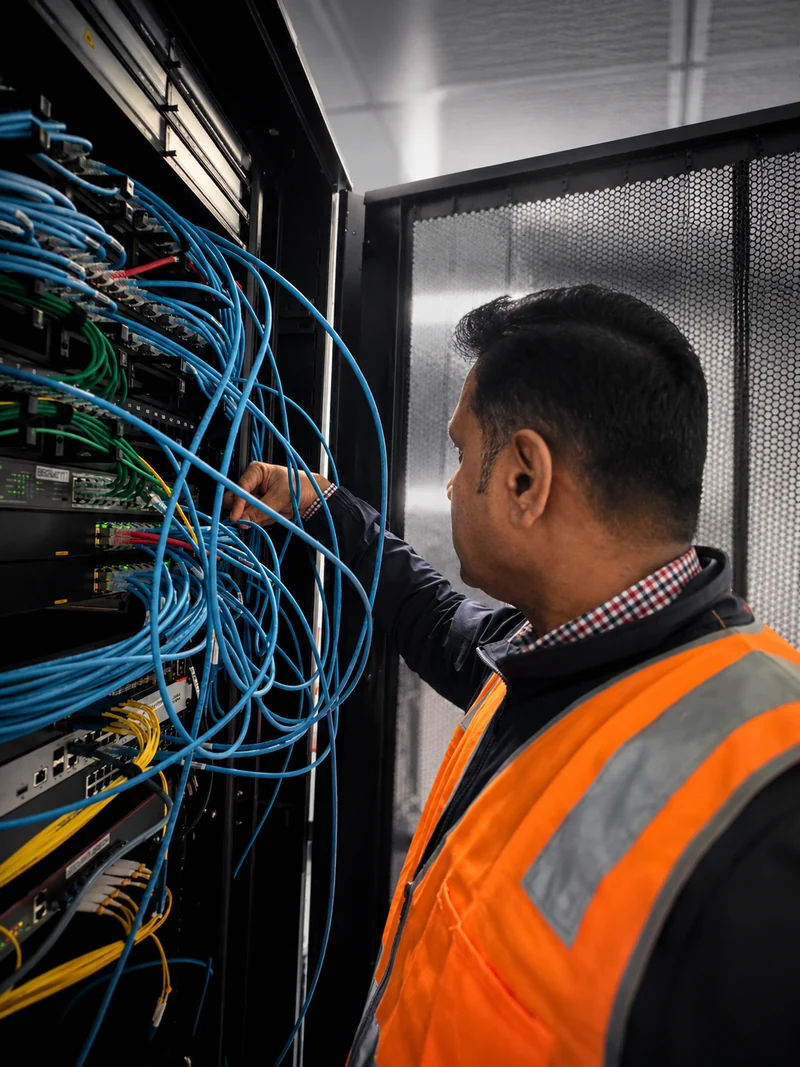
Coordinate site engineering for deployments, physical faults and equipment replacement. Site attendance, geography, access, spares and dispatch windows are agreed within the service scope.

04
Use incident evidence to improve the next operating cycle.
Track network health, incident trends, recovery times and capacity. Use post-incident reviews to direct preventative work and review contractual service measures.
Use these supplied targets to frame discovery and an agreed measurement plan.
| Service measure | Illustrative baseline | Proposed target |
|---|---|---|
| Initial incident acknowledgement | 30–60 minutes | Under 15 minutes, subject to agreed criticality and SLA |
| Alarm-noise suppression | Manual / static thresholds | Up to 70% reduction, validated against event quality |
| Mean time to detect | 15–30 minutes | Under 2 minutes for agreed telemetry and event types |
| Mean time to repair | 4.5+ hours | Below 2 hours as a scenario target; incident mix matters |
| Avoidable field dispatch | Scope-dependent baseline | 30% reduction scenario for remote pre-dispatch checks |
| Coverage continuity | Single-location shifts | Agreed global handover and escalation arrangements |
These are not universal industry averages or guaranteed outcomes. Confirm baselines, exclusions, dependencies and contractual service levels during scoping.
Retain control, outsource defined responsibilities or introduce an assurance layer around an existing stack.
MODEL A
Augment your team with agreed overnight coverage, L1/L2 triage or L2/L3 specialist escalation. Your organisation retains the agreed architecture and operating responsibilities.
Scope this model →MODEL B
Delegate the monitoring, incident coordination, ITSM and vendor responsibilities defined in the service scope. Availability obligations and field dispatch arrangements are contractual.
Scope this model →MODEL C
Integrate correlation, analytics and approved workflow support with your existing operations tools. Validate data quality, integration and operator review before expanding automation.
Scope this model →Use your network footprint and assumptions to explore an indicative financial case.
Explore annual value, MTTR change, dispatch savings and payback.
Launch ROI calculator →
Create a reviewable brief around footprint, service model and operating priorities.
Start scoping →Explore related scope and the original project experience.
Start with the current operating model, evidence and the service outcomes you need.